Are Key Locking Inserts Corrosion-Resistant? A Supplier’s Practical Deep Dive Key Locking Inserts
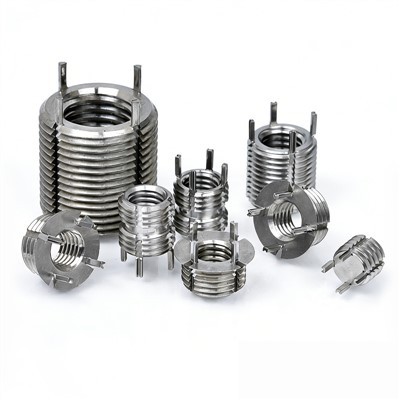
When a customer walks into my office last month, he was carrying a stack of failed industrial components—small, threaded inserts that had corroded so badly inside a pair of heavy-duty agricultural gear assemblies, they’d snapped clean off mid-harvest. “I ordered these for their ‘corrosion-resistant’ rating,” he said, tapping a smudge of rust dust on his fingertips, “but they fell apart faster than the cheap ones I used 10 years ago.”
That conversation isn’t an anomaly. For decades, key locking inserts (the internally threaded components with small, spring-loaded key tabs that lock into a host material’s pre-drilled holes to eliminate rotation) have been a go-to solution for aerospace, automotive, agricultural, and medical applications where thread strength and vibration resistance are non-negotiable. But there’s persistent confusion about their corrosion performance—and as a supplier who’s worked with these parts for 12 years, I get asked every week: Are key locking inserts actually corrosion-resistant, or is that just marketing fluff?
The short answer is: It depends. Not all key locking inserts are created equal, and their corrosion resistance hinges on three core factors: base material, surface finish, and the environment they’re operating in. Let’s break this down like we would for a customer standing at my showroom, not a textbook.
First, the base material. This is the foundation of any insert’s ability to fight rust and degradation, and it’s where most budget shortcuts happen. The cheapest key locking inserts on the market are made from plain carbon steel—think mild, uncoated metal that will turn rust brown in just a few months if exposed to moisture, salt, or industrial fumes. That’s exactly what my frustrated agricultural customer got. But for applications that need real corrosion resistance, two materials dominate: 300 series stainless steel and nickel alloy (like Inconel 625 or Monel).
300 series stainless steel, specifically 304 and 316, is the workhorse of corrosion-resistant inserts. The “300 series” stands for a family of steel alloys with at least 10.5% chromium—enough to form a thin, invisible oxide layer on the surface that self-heals if scratched, preventing rust from spreading. The difference between 304 and 316 is critical for harsh environments: 316 has 2-3% molybdenum, which makes it resistant to chloride corrosion (think saltwater, road salt on trucks, or fertilizer dust on farm equipment). That’s why I only recommend 316 for coastal or agricultural applications where exposure to salt or chemicals is common. Nickel alloys, meanwhile, take this a step further. Monel is a nickel-copper alloy that stands up to acids and saltwater far better than even 316 stainless, making it ideal for marine components or chemical processing equipment. Inconel, a nickel-chromium alloy, is used in high-temperature aerospace parts where corrosion and heat go hand in hand.
But even a great base material can fail if the surface finish is skipped or done wrong. This is where suppliers often cut corners to undercut competitors, and it’s a mistake that costs customers dearly. For example, a 304 stainless steel insert that’s only passivated (a chemical treatment that removes free iron from the surface and boosts that chromium oxide layer) will outperform an insert that’s just pickled and oiled. Passivation is non-negotiable for stainless steel inserts: without it, tiny traces of iron from manufacturing tools remain on the surface, leading to “red rust” (carbon steel rust) seeping through even the stainless steel’s protective layer. For nickel alloys, things get even more finicky: Monel inserts need a nickel-plated finish for extra protection against acid corrosion, while Inconel often requires a hard, ceramic coating for high-wear applications that also resist oxidation at 1,000°F or higher.
Now, let’s talk about the environment, because corrosion resistance isn’t a one-size-fits-all metric. I’ve had customers call and ask for “100% corrosion-resistant key locking inserts” for a medical device that’s used inside the human body, and another ask for the same part to hold up in a saltwater aquaculture system. The needs are totally different. For the medical device, 316L stainless steel (a low-carbon version of 316 that’s safe for bodily fluids) is perfect, because it resists body fluids and repeated autoclave sterilization. For aquaculture, Monel inserts will last 10+ years, while 316 might corrode in as little as 2. That’s because corrosion is a chemical reaction—each environment has different “corrosive agents” that react with metal at different rates.
I’ll also address a common myth here: many people think “corrosion-resistant” means “rust-proof forever.” That’s not true. Even the best nickel alloy will degrade if it’s exposed to a constant flow of highly concentrated sulfuric acid, or if it’s installed in a host material that’s itself corrosive (like uncoated aluminum, which can cause galvanic corrosion when paired with steel inserts). Galvanic corrosion is a big one that’s often overlooked. If you pair a steel insert with a magnesium host, for example, the magnesium will corrode to protect the steel—so even a stainless steel insert will look rusted in months. That’s why I always include a material compatibility guide with every order, something many budget suppliers skip entirely.
Let’s go back to that agricultural customer from my opening. His mistake was ordering a “corrosion-resistant” insert that was actually made from 201 stainless steel, a lower-grade 300 series variant that’s cheap but only has 4-5% chromium—so it forms a weak oxide layer that breaks down quickly in fertilizer and dust. He also didn’t ask about surface finish: the supplier had skimped on passivation, so the insert was already developing tiny rust pits when it arrived. When I showed him a sample of our 316 stainless steel, passivated inserts, he told me he’d replace all the failed parts with these and add a galvanic barrier coating to the aluminum gear housing to prevent future corrosion. That’s the right move, and it’s why I spend 30 minutes with every customer to walk through their specific application, not just sell them a part.
As a supplier, I also test every batch of key locking inserts for corrosion resistance before they leave our facility. We use two standard tests: salt spray (ASTM B117) and immersion corrosion testing. The salt spray test exposes parts to a 5% salt solution at 95°F for 500 hours—if a part has more than 5% surface rust after that, it’s rejected. For high-stakes applications like aerospace, we also do intergranular corrosion testing, which checks if the material’s grain boundaries are susceptible to corrosion (a common failure point in poorly heat-treated stainless steel). I keep a log of every test on file for 7 years, so if a customer ever has an issue, I can pull up exactly what their parts were tested to.
I know there are a lot of copycat suppliers out there marketing generic inserts as “corrosion-resistant” without any testing or material transparency. That’s why I always tell customers to ask three questions before ordering: What base material are the inserts made from? Did you perform a passivation or surface treatment? Can I see a copy of your corrosion test report? If a supplier can’t answer those, walk away—you’re not buying a part, you’re buying a gamble.
In the end, key locking inserts can be extremely corrosion-resistant—but only if you pick the right material, the right finish, and match it to your operating environment. For 12 years, my team has focused on that: we don’t sell cheap carbon steel inserts, we offer three grades of stainless steel and nickel alloys, and every order comes with a full material data sheet and test results. That’s why our customers in medical, aerospace, and marine industries come back to us, instead of chasing the lowest price.

If you’re working on a project where insert corrosion could lead to costly failures—whether that’s agricultural gear, automotive components, medical devices, or marine equipment—let’s talk. We’ll walk through your requirements, help you pick the right insert for your needs, and provide the testing and documentation you need to move forward. Don’t let a wrong insert turn a routine part into a catastrophic failure.
Thread Repair Kit References
- ASM International. (2005). Corrosion: Understanding the Basics. Materials Park, OH: ASM International.
- ASTM International. (2021). Standard Test Method for Salt Spray (Fog) Testing (ASTM B117-21). West Conshohocken, PA: ASTM International.
- Davis, J. R. (2001). Stainless Steels. Materials Park, OH: ASM International.
- National Association of Corrosion Engineers (NACE). (2018). Galvanic Corrosion: A Practical Guide. Houston, TX: NACE International.
Locking Inserts Technologies Co., Ltd.
As one of the most professional key locking inserts manufacturers and suppliers in China, we’re featured by quality products and good service. Please rest assured to wholesale bulk key locking inserts in stock here from our factory. Also, custom service is available.
Address: 205, 2/F, Bldg. A8, Zhizaogu Ind. Park, No.26 Xingye 5th Rd, Bao’an Dist., Shenzhen, Guangdong, P.R.China
E-mail: sales@lockinginserts.com
WebSite: https://www.lockinginserts.com/
