If you’ve ever worked in wind power project design or maintenance, you know that the quiet reliability of a component like a fuse holder is just as critical as the turbines towering above farmlands and coastal plains. As a supplier of wind power-specific fuse holders, I field this question at least twice a week from electrical engineers, maintenance technicians, and project managers: “What’s the rated current of a common wind power fuse holder?” The answer isn’t a one-size-fits-all number—wind power systems have unique operational demands, so the “common” rated current depends on where the holder sits in the turbine’s electrical system, from the nacelle to the base transformer. Let me break this down, share what I’ve learned from 10 years in this industry, and explain why getting this spec right can make or break a turbine’s uptime. Wind Power Fuse Holder
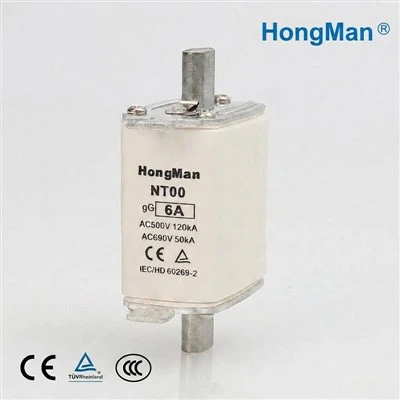
First, let’s ground this in how a typical utility-scale wind turbine’s electrical system works, because that’s where our fuse holders live. A modern turbine has a nacelle at the top of the tower, housing the gearbox, generator, and power electronics that convert the generator’s variable AC power (based on wind speed) into consistent, grid-compatible power. That power then flows down the tower’s internal cabling to a step-up transformer at the tower base, which boosts voltage for transmission to the substation. Fuse holders are installed at every major electrical node in this path—they protect cables, inverters, and other components from overcurrent events, like a short circuit or sudden surge from a gust of wind. Each node has different current requirements, so the rated current of the holder changes accordingly.
When a customer first asks about “common” rated currents, I usually start with the two most widely used values for standard onshore wind turbines, which make up 70% of the global installed base right now. The first is 125A. That’s the most common rated current for fuse holders used in the nacelle’s low-voltage (LV) branch circuits—think control systems, cooling fans, and the generator’s output feeders before the main inverter. For a 2MW turbine, for example, the nacelle’s main generator might output up to 1,800A at peak, but branch circuits are smaller, and their fuse holders are sized to match the overcurrent protection needs of individual components. Wait, let’s clarify: the rated current of the holder itself is different from the fuse’s rated current. The holder is the physical component that secures the fuse, so its rated current is the maximum continuous current it can safely carry without overheating or degrading over time. For nacelle branch circuits, most standard fuse holders are rated for 125A, because those circuits rarely draw more than 100A under normal operation, leaving a safety buffer for minor surges.
The second common rated current is 250A, which is what you’ll find on most medium-voltage (MV) fuse holders used in the nacelle’s main power feed and the tower’s internal cabling run to the base transformer. For turbines rated between 2MW and 5MW—today’s most popular utility-scale models—those main feeders carry anywhere from 200A to 220A at peak load, so a 250A rated holder is the sweet spot. I’ve seen a lot of contractors try to cut costs by using a 125A holder here, but that’s a mistake. The vibration in the nacelle and tower, combined with temperature swings that range from -40°F in cold climates to 120°F in desert installations, means the holder needs to handle consistent current plus some extra headroom. A 250A rated holder isn’t just bigger—it’s built with thicker contact blades and corrosion-resistant materials that stand up to wind’s harsh conditions, which is why it’s become the common spec for main power circuits.
But wait, that’s onshore. For offshore wind turbines, which are growing fast (the U.S. just approved its first large-scale offshore wind farm last year), the “common” rated currents go higher. Offshore turbines have to handle saltwater corrosion, higher wind speeds, and more powerful power electronics to transmit power long distances to shore. That’s why our most popular holders for offshore projects are 400A rated. The main power feed for a 10MW offshore turbine can draw up to 380A at full load, so a 400A holder provides a safety factor that’s non-negotiable in marine environments. I worked on a project off the coast of Germany a few years back where a competitor tried to use 250A holders for a new 8MW turbine; within six months, overheating had corroded the contact points, and the turbine was offline for three weeks waiting for replacement parts. That’s the kind of story that sticks with you, and it’s why we design all our offshore fuse holders to exceed standard industry ratings, including that 400A common spec.
Now, let’s talk about why rated current isn’t just a number you pull from a datasheet. Wind power holders have to meet specific standards that make them different from fuse holders used in automotive or commercial buildings. The main standards here are IEC 60269-1 (for low-voltage fuses) and IEC 60269-2 (for LV fuse-links), plus industry-specific add-ons from the International Electrotechnical Commission’s wind power working group. Those standards dictate that a wind power holder rated for 125A must carry at least 125A continuously at 40°C without exceeding a 50°C temperature rise at the connections. But in a wind turbine, ambient temperatures can vary—so we also add a temperature derating curve to every product we sell. A 125A holder might only be able to carry 100A if the nacelle is sitting in 50°C heat, so engineers have to account for that when sizing components.
I also get asked a lot about what happens if you use a holder with the wrong rated current. If you go too low, like using a 100A holder where a 250A is needed, the holder’s contacts will overheat over time. Even a small, consistent overcurrent (just 10A too much) can cause the metal contacts to expand, loosen, and create more resistance, leading to a vicious cycle of more heat and eventual failure. For a turbine’s main power circuit, that failure can shut down the entire turbine, costing a wind farm operator thousands of dollars a day in lost production. If you go too high—say, using a 400A holder for a 125A branch circuit—you’re not getting the overcurrent protection you need. The fuse might blow, but the holder itself is bigger, and the contact pressure might not be tight enough for small fuses, leading to arcing that can damage both the fuse and the holder.
Over the years, I’ve seen how the demand for wind power has shifted what’s considered a “common” rated current. Ten years ago, most turbines were 1MW to 2MW, so 80A was a common holder rating. Now, as turbines get larger, that number has gone up. The global push for renewable energy has led to more onshore 5MW turbines and offshore 15MW models, so our product line has evolved to meet that demand. That’s why we still stock 125A and 250A holders for standard onshore projects, and keep 400A and even 500A holders in stock for offshore and heavy-duty onshore projects in high-wind regions.
One thing I always tell new engineers is to work with a supplier that understands the wind power industry, not just generic electrical components. A fuse holder for a wind turbine isn’t the same as one for a office building’s electrical panel. It has to withstand constant vibration, extreme temperatures, and exposure to dust, salt, and humidity. The rated current is a starting point, but you also have to consider the holder’s mechanical design, material (we use tin-plated copper for contacts to resist corrosion), and compliance with industry standards like UL 508A for North American projects and IEC 60947 for global projects.
If you’re a project engineer specifying holders for a new turbine, or a maintenance technician replacing a faulty holder on an existing one, don’t just take a generic spec at face value. Look at where the holder is installed: is it in a nacelle control circuit, a main power feeder, or an offshore base transformer? Each of those locations has different current demands and environmental stresses. For most standard onshore wind projects, that means 125A for branch circuits and 250A for main power feeders. For offshore, 400A is the new common standard.
At the end of the day, the rated current of a common wind power fuse holder isn’t a static number—it’s a spec that’s evolved along with the wind power industry. As turbines get bigger and more installations move offshore, we’re seeing higher rated currents become standard, but 125A and 250A will always be the workhorses for most onshore projects. The key is matching that rated current to the unique demands of your turbine’s electrical system, and partnering with a supplier that has on-the-ground experience in wind power to make sure you get the right part for the job.

If you’re currently working on a wind power project and need help specifying fuse holders that meet your exact current and environmental requirements, I’m here to help. We stock a full line of wind power-specific fuse holders, offer custom sizing for unique project needs, and provide technical support to make sure every component works as hard as your turbine.
NH Fuse Holder References:
IEC 60269-1: Low-voltage fuses – Part 1: General requirements
IEC 60269-2: Low-voltage fuses – Part 2: Supplementary requirements for fuses for use by authorized persons (fuses mainly for industrial application) – Sections Two to Twelve
UL 508A: Industrial Control Panels
Global Wind Energy Council (GWEC): 2024 Wind Power Market Report
Zhejiang Hongman Electric Technology Co., Ltd.
Zhejiang Hongman Electric Technology Co., Ltd. is one of the most professional wind power fuse holder manufacturers and suppliers in China. We have world-leading production equipment and strong manufacturing capabilities. Please feel free to wholesale bulk cheap wind power fuse holder from our factory. All customized products are with high quality and competitive price.
Address: No.115 Xinguang Avenue, Xinguang Industrial Zone, Liushi Town, Wenzhou City, Zhejiang Province
E-mail: yzm@chinahongman.com
WebSite: http://www.cnfuse.com/
