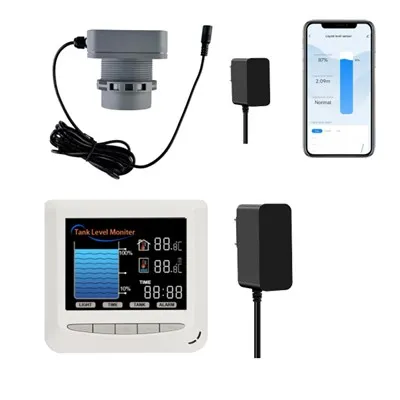
As a supplier of ultrasonic tank level sensors, I often encounter customers who are curious about the response time of these devices. Response time is a critical parameter that can significantly impact the efficiency and effectiveness of tank level monitoring systems. In this blog post, I will break down what response time means in the context of ultrasonic tank level sensors, explore the factors that influence it, and discuss why it matters for your applications. Ultrasonic Tank Level Sensor
Understanding Response Time
Response time, in the realm of ultrasonic tank level sensors, refers to the time it takes for the sensor to detect a change in the tank level and provide an updated measurement. It is typically measured from the moment the level changes to the point when the sensor outputs a corresponding signal. This parameter is crucial because it determines how quickly your system can react to changes in the tank’s contents, whether it’s a liquid, powder, or granular material.
For instance, in a chemical processing plant, a sudden drop in the level of a reactant in a tank could indicate a leak or a malfunction in the feeding system. A sensor with a fast response time can detect this change almost immediately, allowing operators to take prompt action to prevent potential hazards or production disruptions. On the other hand, a slow – responding sensor might delay the detection, leading to more severe consequences.
Factors Influencing Response Time
Several factors can affect the response time of an ultrasonic tank level sensor. Let’s take a closer look at some of the most significant ones:
Sensor Design and Technology
The internal design and technology of the sensor play a vital role in determining its response time. Modern ultrasonic sensors are equipped with advanced signal processing algorithms and high – speed microcontrollers. These components can quickly analyze the ultrasonic signals reflected from the surface of the material in the tank. For example, sensors with pulse – echo technology, which measures the time it takes for an ultrasonic pulse to travel to the surface and back, can provide relatively fast response times.
However, the quality of the sensor’s transducer also matters. A high – quality transducer can generate and receive ultrasonic waves more efficiently, reducing the time required to obtain an accurate measurement. Additionally, sensors with multiple transducers or advanced beamforming techniques can improve the response time by enhancing the signal – to – noise ratio and reducing interference.
Tank Conditions
The conditions inside the tank can have a significant impact on the sensor’s response time. The type of material in the tank is a key factor. Different materials have different acoustic properties, which can affect how the ultrasonic waves propagate and reflect. For example, liquids with high viscosity or foamy substances can absorb or scatter ultrasonic waves, making it more difficult for the sensor to detect the level accurately and increasing the response time.
The temperature and pressure inside the tank can also influence the speed of sound, which is crucial for calculating the level. If the temperature or pressure changes rapidly, the sensor may need to adjust its calculations, leading to a longer response time. Moreover, the presence of obstacles or agitators in the tank can cause interference, disrupting the ultrasonic signals and delaying the measurement.
Installation and Configuration
Proper installation and configuration of the sensor are essential for achieving optimal response time. The sensor should be installed at the correct height and angle to ensure that the ultrasonic waves are directed towards the surface of the material in the tank. Incorrect installation can result in poor signal reception and longer response times.
The sensor’s configuration settings, such as the sampling rate and the filtering parameters, also affect the response time. A higher sampling rate means that the sensor takes more measurements per unit of time, which can lead to a faster response. However, increasing the sampling rate may also increase the power consumption and the amount of data that needs to be processed. Filtering parameters are used to reduce noise and interference, but overly aggressive filtering can smooth out rapid changes in the level, increasing the response time.
Why Response Time Matters
The response time of an ultrasonic tank level sensor is not just a technical specification; it has real – world implications for your business. Here are some reasons why it matters:
Safety
In industries where safety is a top priority, such as oil and gas, chemical, and food processing, a fast – responding sensor can help prevent accidents. For example, in a storage tank for flammable liquids, a sudden drop in the level could indicate a leak. A sensor with a short response time can detect this change quickly, allowing operators to shut off the valves and take appropriate safety measures before a dangerous situation develops.
Process Efficiency
In manufacturing and production processes, the ability to monitor tank levels in real – time is crucial for maintaining efficiency. A sensor with a fast response time can provide accurate and up – to – date information about the amount of material in the tank, enabling operators to optimize the feeding and production processes. This can lead to reduced waste, increased productivity, and lower production costs.
Quality Control
In industries where product quality is critical, such as pharmaceuticals and cosmetics, accurate tank level monitoring is essential. A fast – responding sensor can detect any changes in the level of raw materials or ingredients, ensuring that the correct amounts are used in the production process. This helps to maintain consistent product quality and reduces the risk of product recalls.
Measuring and Improving Response Time
Measuring the response time of an ultrasonic tank level sensor can be done using specialized testing equipment. The sensor is typically subjected to a known change in the tank level, and the time it takes for the sensor to output a corresponding signal is recorded. This measurement can be repeated multiple times to ensure accuracy.
To improve the response time of your sensor, you can take several steps. First, choose a high – quality sensor with advanced technology and a fast – processing microcontroller. Second, ensure that the sensor is installed correctly and configured optimally. Third, regularly maintain and calibrate the sensor to ensure that it is operating at its best.
Conclusion
Response time is a crucial parameter for ultrasonic tank level sensors. It can significantly impact the safety, efficiency, and quality of your operations. As a supplier of these sensors, we understand the importance of providing sensors with fast response times and reliable performance. Our team of experts can help you choose the right sensor for your specific application and ensure that it is installed and configured correctly.
Ultrasonic Flow Sensor If you are in the market for an ultrasonic tank level sensor and want to learn more about how our products can meet your needs, we encourage you to reach out to us. Our sales team is ready to answer your questions, provide detailed product information, and discuss your requirements. We look forward to working with you to find the best solution for your tank level monitoring needs.
References
- Smith, J. (2018). Ultrasonic Sensor Technology: Principles and Applications. Publisher: ABC Press.
- Johnson, A. (2020). Tank Level Monitoring: Best Practices and Technologies. Journal of Industrial Engineering, 15(2), 123 – 135.
- Brown, C. (2019). Factors Affecting the Performance of Ultrasonic Level Sensors. Proceedings of the International Conference on Sensor Technology, 45 – 52.
Shenzhen Fineherc Technology Co., Ltd.
As one of the most experienced ultrasonic tank level sensor suppliers in China, we’re featured by quality products and low price. Please feel free to buy discount ultrasonic tank level sensor made in China here from our factory. Welcome to view our website for more information.
Address: 5th Floor, Building D, No. 39, Keji East Road, Torch Development Zone, Zhongshan City,China
E-mail: fineherc@hotmail.com
WebSite: https://www.fineherc.com/
